
Fiona Neoh
Professional Head of Asset Integrity, RSSB
In January, Storm Goretti lashed wintry Britain with rain, snow, and high winds. One gust reached a very high speed of 99 mph. Schools were closed, thousands of homes were without power, and the Met Office reported that, in Cornwall, nearly 100 trees were blown over.
For the railway network, fallen trees on the line test rail systems to the limit and can cause havoc. Last September, for example, a train struck a tree on the line between Swansea and Neath. This caused major delays across the Pembrokeshire area.
Between January 2000 and June 2024, there were 560 derailments. Nine of those were due to trains striking trees. That’s around 2% of all derailments and 5% of those involving passenger trains.
These events bring safety risk, speed restrictions, delays, line closures, cost, and knock-on congestion.
But how can we know when a tree will fall, and if it will impact the railway? Network Rail asked us to investigate.
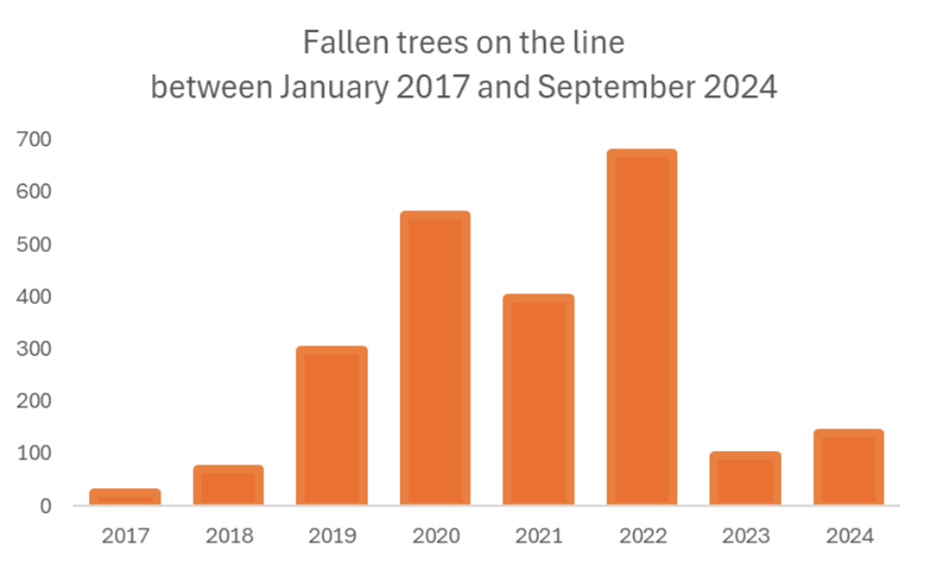
Over the past 9 years, our industry has been collecting data in Safe Insights on fallen tree events. The graphic above shows the scale, and the unpredictability, of the problem.
The years with the most events—2020 and 2022—correlate to major named storms, just like Goretti. In February 2020 there were more than 200 fallen tree events, the same month as Storm Ciara. In February 2022, Storm Eunice coincided with almost 500 fallen tree events.
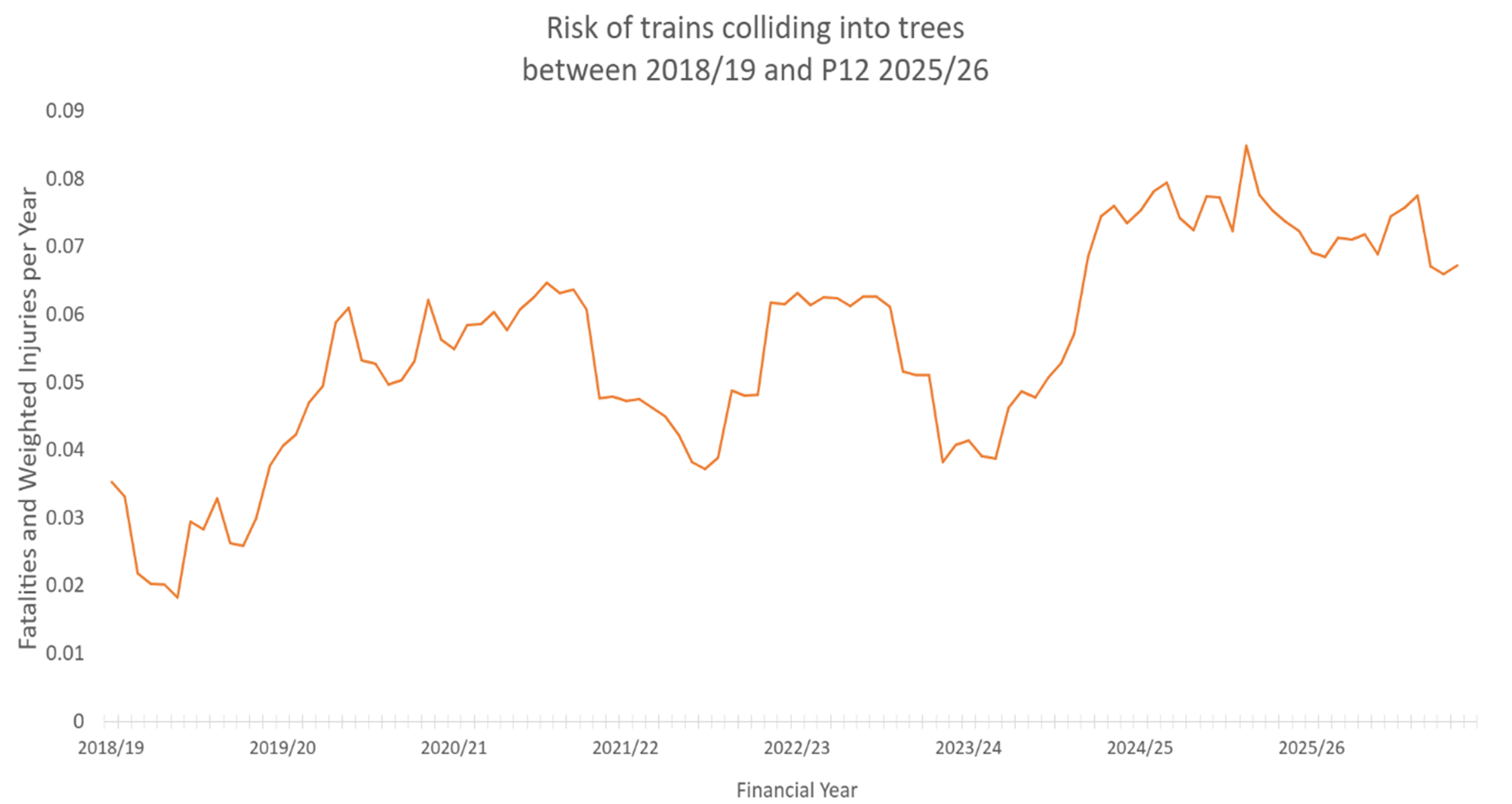
The line graph shows how the risk of trains colliding with trees has changed over the past eight years. The data is taken from the Precursor Indicator Model.
Understanding the scale of the issue was the first step. The next step is underway.
We’re now working to add a new string to PRIMA’s bow—PRIMA Wind. PRIMA Rain already models the risk of earthwork failure and can be used to mitigate heavy rainfall incidents. With trials for PRIMA Wind on the horizon, this new capability could soon be helping to mitigate the risk of an incident caused by high wind gusts.
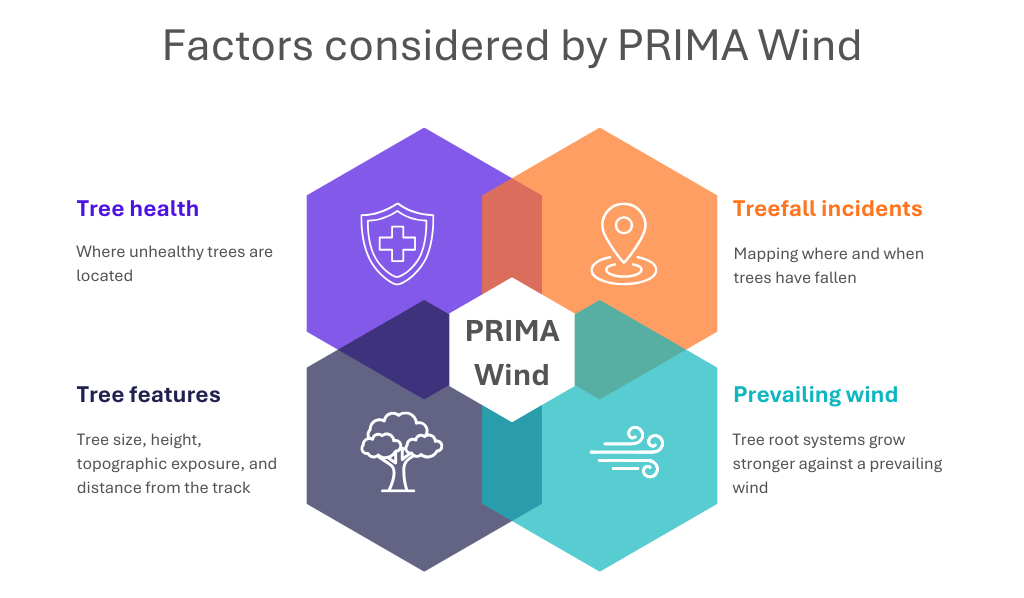
PRIMA integrates several processes together to offer decision-making support to Network Rail staff.
The new wind vulnerability model is a statistical model developed to estimate the risk of trees falling on to the track, based on wind speed, canopy coverage, and wind direction. This is dependent on the distribution of trees near the running line and the qualities of those trees.
The risk model uses output from the vulnerability model to calculate the risk of a train striking a fallen tree or derailing due to a tree falling on the line.
It will support decision-making by teams with expertise in geotechnics and in drainage and lineside management. Specifically, it delivers critical insight to those teams, enabling them to make balanced risk-based decisions when developing pre-determined operational responses to adverse weather conditions.
Introducing PRIMA Wind will help us mitigate the risk from fallen trees on the line as part of operational response planning.
This will give us a greater operational resilience on the network and a reduction in costs for operators, all thanks to modelling data.