
RSSB logo
Menu
Register
  • RSSB logo
  • Ask RSSB
  • About RSSB
    • About Us
      Who We Are
      What We Do
    • Insights and News
      • RSSB Podcast
    • Groups and Committees
      Career Opportunities
      • Employee Wellbeing
    • Member Enquiries
  • Services and Resources
    • Case Study Library
    • Events and Webinars
    • Consultancy
      Training
    • Railway Documentation and Drawing Services
      Railway Industry Supplier Approval Scheme
      • Customer testimonials
    • Research Catalogue
      Standards Catalogue
  • Safety and Health
    • The Rail Health and Safety Strategy
      Safety Risk Groups
      Train Protection Strategy
      Wellbeing Groups
    • Asset Integrity
      Fatigue
      Freight Safety
      • Freight Precursor Indicator Model
    • Health and Wellbeing
      Level Crossings
      Occupational Health and Safety
      • Welfare Facilities Charter
      • Welfare facilities: Initiatives to improve access
      • Welfare facilities research and trials
    • Passenger Operations
      Passenger and Staff Assaults
      Train Operations
    • Trespass and Suicide
      Safety and Health Tools & Resources
      Common Solutions
  • Standards
    • Types of standards and how they work
      • National Technical Specification Notice guidance
      Defining the future of standards
      • Rail Standards Strategy
      • Railway Standards Code and Standards Manual
    • Using standards
      • Latest updates to standards
      Standards self-assessments
      Rail Standards Consultations
    • Where we use rail standards
      • Control, command and signalling
      • Data, systems and telematics
      • Energy
      • Infrastructure
      • Plant
      • Rolling stock
      • Traffic operation and management
    • Standards groups and committees
      Digital Railway Assurance Steering Group
    • Standards Catalogue
      Rule Book App
  • Sustainability
    • Sustainable Rail Blueprint
    • Net zero carbon rail
      • Carbon reduction
      • Your guide to carbon accounting
      A quieter railway
      Clean Air
    • Prepared for a Changing Climate
      • Climate change adaptation metrics
      A Railway for Nature
      Zero Waste
      Protect and Conserve Water
    • Maximising Social Value
      Rail at the Heart of Communities
      Careers, Economy & Sustainable Growth
      People-centred Rail
    • Sustainability Tools and Resources
      Sustainable Rail Groups
  • Research
    • About the Research Programme
      Engage with the Research Programme
    • How Research Delivers Benefits
      Collaboration in Research
      • World Congress in Rail Research
    • Flagship Research Activities
      • Adhesion
      • Artificial Intelligence
      • Freight Research Programme
      • Performance
    • Research Highlights - Winter 2026
      Rail Technical Strategy
    • Research Catalogue
      SPARK
  • Join RSSB
    • Join RSSB
    • International RSSB
      Becoming a Member - GB and Overseas
    • Find out Who Joins RSSB and Why
    • What our members and affiliates say
    • Membership Benefits
      Membership Offerings
      Our Business Plan
Register
  • RSSB
  • Standards
  • Types of Standards and How They Work

Types of Standards and How They Work

Introductions

Standards help rail companies to address legal requirements and other obligations. Using standards can offer a set of powerful business and marketing tools for organizations of all sizes. You can use them to fine-tune your performance and manage the risks you face while operating in more efficient and sustainable ways; they’ll allow you to demonstrate the quality of what you do to your customers; and they help you to see how to embed best practice into your organisation.

Understanding the standards legal framework
Watch the webinar

Types of Railway Standards

Rail Industry Standards
Rail Industry Standards (RISs) are industry-agreed and define how subsystems should be operated or managed.
National technical rules
These provide controls to ensure essential requirements specified in the Railways (Interoperability) Regulations 2011 (as amended) are met.
National Safety Rules
These are common railway safety requirements that are imposed by the government and regulator on those operating the railway.
National Technical Specification Notices NTSNs
These define the technical and operational standards to satisfy requirements and ensure interoperability.
European and International Standards
These help facilitate trade between countries, create new markets, enable innovation, and cut compliance costs across all sectors.
Company and Project Standards
Standards may be agreed at company or project level. Find out when organisations need to develop company-level standards.

Standards Guidance & Resources

The Rule Book
The Rule Book is a series of documents that contain direct instructions for railway staff. They are termed as National Operations Publications within the Group Standards Code.
RSSB technical notes
RSSB’s technical notes to help with the application of standards guidance or legislation. They may relate to one specific standard multiple standards or pieces of legislation relating to a specific topic.
Standards self-assessments
Gain a better understanding of standards with our handy tests.
National Technical Specification Notice guidance
This supports users of NTSNs and related processes.
  • Different Types of Standards And Rules

    The diagram below reflects the different types of standards and rules which exist today.
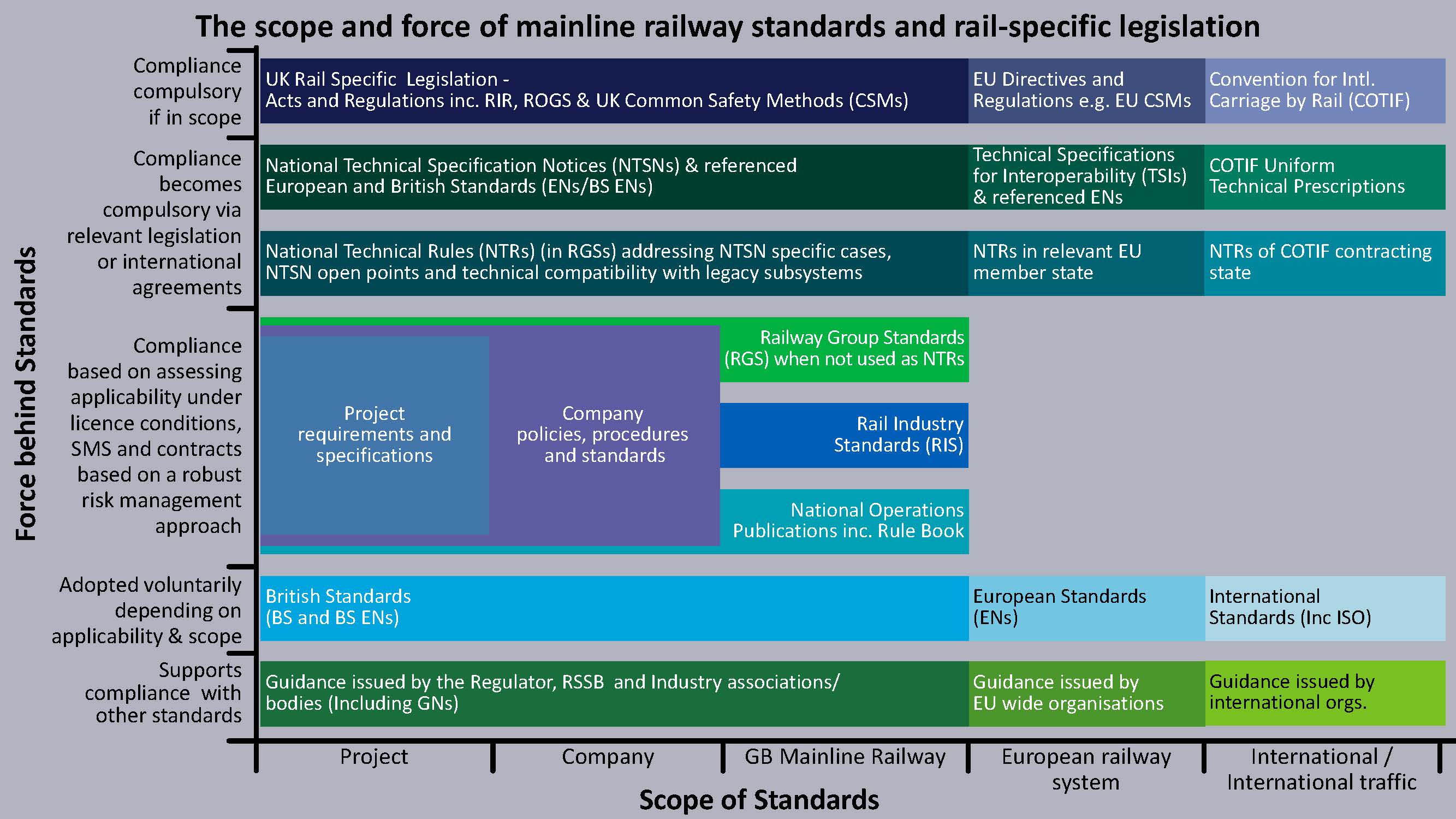
    The different types of standards and rules which exist today

Haven’t found what you’re looking for?
Get in touch with us for more information.

Tom Lee
Tom Lee
Tel: 020 3142 5509
tom.lee@rssb.co.uk
Other RSSB sites
Standards Consultations
CIRAS
RISAS
RISQS
SPARK
Catalogues
Research Catalogue
Standards Catalogue
Policies & Statements
RSSB’s Gender & Ethnicity Pay Gap
Accessibility Statement
Contact us
Customer Portal
© 2026 Rail Safety and Standards Board Ltd All Rights Reserved Rail Safety and Standards Board Ltd is Registered in England under company number 04655675
Cookie Policy
Privacy Notice
Terms of Service